

Lars Frederiksen shared a super interesting, brand new (released three days ago!) paper with me by Gary King and Steven Worthington. It is already making the rounds on Academia SoMe (here are various threads on X).
Here is the basic result in the paper: Give the same manuscript to a very good human referee (or, reviewer, if you prefer) and to a frontier AI model, conceal who wrote which report, and ask which review is better. The AI wins. Not occasionally, and not only on mechanical dimensions of reviewing. It wins by large margins.
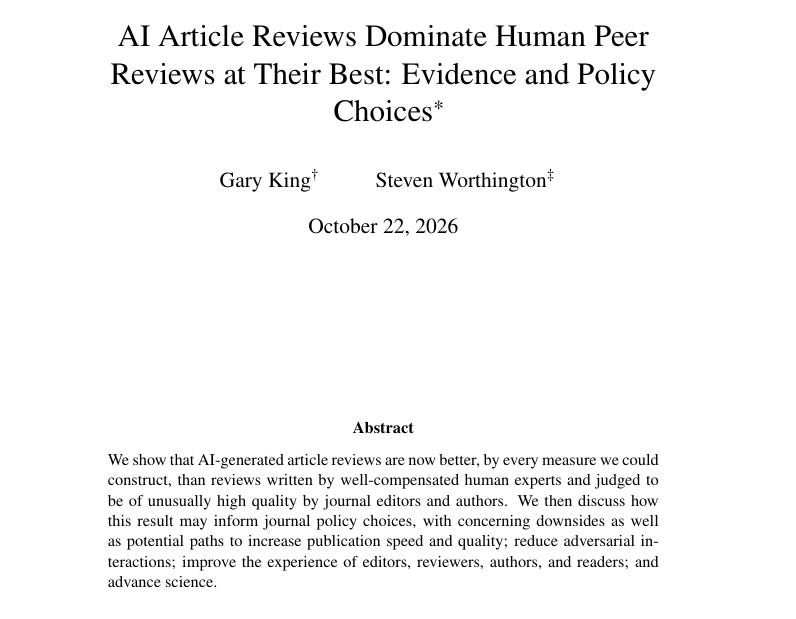
King and Worthington compare AI-generated referee reports with unusually good human reports on the same manuscripts. An independent AI judge prefers the AI review in every decided overall comparison. One immediately thinks that perhaps there may be some kind of hidden AI bias here? But, King and Worthington also let former editors of leading scholarly journals assess the reports. judging blinded pairs without knowing that one report was machine-generated, these human experts, who are presumably high in experience-based judgment, prefer the AI report 87 percent of the time. Across seven dimensions—methods, theory, weaknesses, framing, communication, figures and tables, and sources—the pattern is much the same.
The obvious conclusion is that AI is coming for the reviewer! However, I think there is something deeper here, namely that the paper points to the fact that we have been asking referees to do two different things.
One is analysis. A referee checks the argument, probes the methods, finds errors and omissions, identifies missing literature, and asks whether the conclusions follow from the evidence. The other is judgment: Is this contribution interesting? Does it matter? Is an unconventional argument promising or merely wrong? Is this the sort of paper this journal ought to publish? Many of you will be familiar with the little boxes-ranging from “Accept as is” to “reject”—in the reviewer modules of the journals. Judgment compressed. Of course, the text fields in the module with “comments for the editor” serve to unpack that judgment somewhat.
Because I find the analysis task much easier than the judgment part, I have long been attentive to this distinction (also because frankly I am often baffled by the judgment of colleagues on papers, particularly when they dismiss a paper on the basis of what seems to me a very flimsy judgment call).
I use judgment here in the Knightian sense: decision-making when there is no known (non-trivial) model or decision rule that can supply the answer. Judgment cannot be reduced to processing more information or applying a more sophisticated algorithm.
King and Worthington’s result suggests that a large part of what we call peer review consists of analytical tasks rather than judgment. And, perhaps not surprisingly, that frontier models may already perform those tasks better than excellent human specialists. But, their experiment does not show that AI should decide which scientific contributions deserve attention, prestige, and publication. The authors are quite careful on this point: their evidence concerns constructive advice for improving papers, not the basis on which editors should make publication decisions.
The institutional implication is an unbundling. If AI has acquired a comparative advantage in criticism while editors retain judgment and responsibility, perhaps the question isn’t only whether AI should “replace peer review,” but also why scholarly publishing continues to bundle these functions together.
A strong human benchmark
King and Worthington have not constructed an easy benchmark. Their comparison is not against the ordinary referee reports familiar to anyone who has spent a few years publishing academic work: the reasonably thoughtful two-pager, the perfunctory paragraph, the request to cite the referee’s papers (😉) and the occasional document suggesting that its author read some other manuscript altogether.
No, their human reports come from rapidPeer, a Harvard-based service designed to produce high-quality pre-submission reviews. Referees are carefully selected, paid well, and asked to read the whole paper and provide comprehensive advice. Authors rated 88 percent of the resulting reports high or very high quality, and former journal editors described them as among the best they had seen.
So, this is not AI versus Reviewer 2 on a bad (or ordinary) day. It is AI versus something approaching Reviewer 2 under laboratory conditions.
The study covers 124 manuscripts and 134 human reviews, spanning empirical, mathematical, and qualitative research. AI reviews were generated with Claude Opus 4.8. In the main condition, it received a purpose-built reviewing prompt and web access. A model from a different family, GPT-5.5, served as the AI judge.
As suggested above, perhaps AI simply prefers AI-generated prose. The authors test for this by rewriting human reviews in AI style, which does not improve their performance. More importantly, three former journal editors judge ten randomly selected pairs without knowing their provenance. Across 30 judgments, they choose the AI review 26 times.
The result also survives a long series of robustness tests. Match reviews by length, compare only topics discussed by both reviews, give the judge the full manuscript, separate older from recent papers, or change models and prompts: the basic result remains. In a replication involving 416 comparisons, AI reviews are preferred in 94 to 97 percent of cases.
Nor does AI win by making things up. The authors find no fabricated citations in the AI reviews. When claims about manuscripts are checked, 5.5 percent of AI claims are judged incorrect, compared with 15.9 percent of claims in the human reports.
What has actually been automated?
It would be easy to read these results as evidence that the referee has been automated. That goes too far.
Peer review combines activities that are relatively close to error detection—checking arguments, empirical designs, references, and exposition—with choices about importance, novelty, taste, and intellectual direction. The first set looks increasingly amenable to AI. The second is much closer to judgment.
King and Worthington have strong evidence that AI can produce better advice to authors. They have not shown that AI is better at deciding what science should be done, what intellectual bets journals should make, or which ideas deserve an audience.
There is no dataset containing tomorrow’s important ideas from which the optimal editorial policy can simply be learned. Editors choose among claims about an intellectual landscape that does not yet exist. If AI substitutes primarily for analysis, therefore, its arrival need not diminish human judgment. Rather, as with AI in general it simply moves the cognitive bottleneck, in this case to editors.
The economics of refereeing
The traditional peer-review system is peculiar from an organizational point of view. Journals use highly specialized labor, supplied mostly without payment, for a mixture of methodological auditing, literature search, error detection, criticism, gatekeeping, and editorial advice. Referees are difficult to recruit (you’ve all seen those LI posts from editors on how they approached 50 colleagues and no one accepted to take a review etc.), reports take several months, quality varies greatly, agreement is low, and the opportunity cost is substantial.
AI changes the economics of this because another review is cheap and fast. It is also iterable. An author can ask for a report, revise the manuscript, request another, and continue until the remaining disagreements concern substantive choices rather than readily detectable problems.
King and Worthington call these “self-supervised revise-and-resubmits.” Much of what currently happens after submission could migrate to before submission. Journals could publish their own reviewing prompts and require authors to submit the resulting report and their response.
This suggests a different allocation of scarce human expertise. Rather than routinely sending every manuscript to several external referees, an editor could receive the paper, a journal-standard AI review, and the author’s response. The editor could commission another AI review using a private prompt and call on a human specialist when a particular question requires one. King and Worthington suggest that decisions that now take months could sometimes take days.
The problem with a very good referee
However, there are reasons for caution here. One is that a referee can be individually excellent while a system of refereeing becomes collectively worse.
AI models embody, to varying degrees, prevailing intellectual conventions. That makes them useful, but science does not advance only by applying existing standards more competently. It also advances when someone rejects a standard, asks an apparently unpromising question, or pursues an explanation that informed observers initially regard as wrong.
To their credit, King and Worthington raise this problem themselves. AI may improve the ideas generated by individual researchers while making the population of ideas more homogeneous. If researchers ask similar systems which questions are promising, which theories are plausible, and which criticisms must be addressed, their work may converge. AI refereeing could similarly improve individual papers while pushing published research toward safer and more conventional arguments.
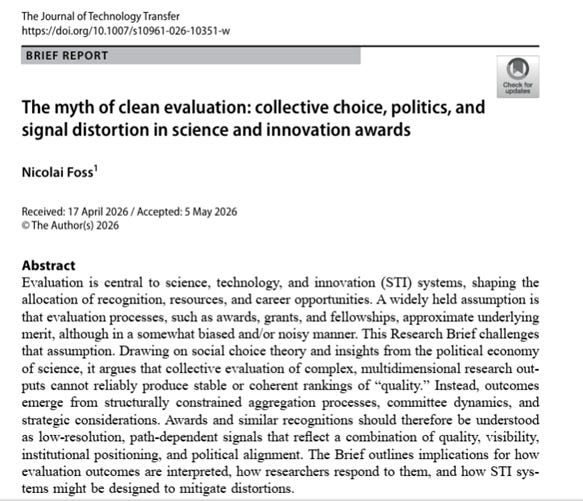
Human disagreement, then, is not necessarily just noise. Some of it reflects differences in theories, priors, tastes, and conjectures about where a field should go. The relevant comparison is therefore not only between an AI referee and a human referee, but between institutional arrangements. We might improve the average paper while reducing the variance of ideas. That possibility cannot be evaluated by showing that AI scores higher on a reviewing rubric. It is a question about the scientific system, as discussed in this paper):
Keep the editor(s)
I think the likely future lies somewhere between the extreme of preserving of traditional peer review and having an autonomous AI journal. There is no good case for the first extreme to the extent that machines write better reports. But, the other extreme may sacrifice too much judgment.
Let machines do more of what they are becoming good at: checking consistency, finding omissions, interrogating methods, locating literature, inspecting tables, and stress-testing claims. Let authors receive much of that criticism before submission rather than six months afterward. Journals can experiment with models and prompts and monitor whether they systematically favor particular theories, methods, or styles. But, this should make editors more important.
An editor relieved of spending hours recruiting several referees for every manuscript can now devote more attention to decisions that are harder to turn into rules. Is the question important? Does the result change how specialists should think? Is an unconventional argument wrong, or merely unconventional? Should a journal take a chance on a paper unlike those it usually publishes? These are decisions about the allocation of scarce attention under uncertainty. They require judgment and someone who accepts responsibility for exercising it.
King and Worthington end up close to this position. Even with extensive use of AI in improving and reviewing manuscripts, they argue that whether a paper meets a journal’s standards should remain with a human editor who has the authority and responsibility to decide.
The case for humans is judgment. In the emerging new division of labor between human and machine cognition in the publishing process, the choice of editor will become even more important. The present system disperses judgment. Editors select referees, referees recommend, and editors decide, often with the recommendations doing much of the work. This also provides editors with a degree of cover: three negative reports make rejection an easy decision. But, if AI takes over more of the analytical work of reviewing, responsibility shifts back toward the editor. Someone still has to decide which papers are worth taking seriously, which unconventional claims deserve a hearing, and which intellectual risks a journal should take. Those choices cannot simply be read off an AI review.
This changes what we should want from editors. Subject-matter expertise will still matter, but so will intellectual breadth, tolerance for heterodoxy, willingness to make decisions under uncertainty, and the capacity to recognize work whose importance is not captured by prevailing criteria. It also makes the selection of editors—and the governance of that selection—super important. An editor exercising genuine judgment shapes not merely the quality of individual papers but the direction and variety of work that a journal legitimizes.
So perhaps the paradoxical consequence of better AI referees is that we should pay considerably more attention to the humans who appoint the editors, and to the editors themselves. As the cost of criticism falls, judgment becomes the scarce input.
Among other things, this may imply that the journals move away from the all-encompassing change of editors every third year or so that some journals practice. I think this is an unfortunate practice as it does away with institutionalized judgment (institutional memory). It may also mean no more AEs who have never published in the relevant journals. It may lead to longer editorial stints, etc. Not bad things in my book.
The unbundling point reaches well beyond journals. A performance review has the same structure: an analysis of the work and a judgment about the person. AI can now do the first part well, which makes it tempting to let the second ride along. A test worth trying for any editor or manager: write your judgment down before you read the AI's analysis, then notice what changed and why.
Great post, and thank you for highlighting the King & Worthington paper. I agree with your conclusion about keeping the editors, with the caveat that many editors today are already not really doing the job they should be doing. Your paragraph summarizes what they should be doing: "An editor relieved of spending hours recruiting several referees for every manuscript can now devote more attention to decisions that are harder to turn into rules. Is the question important? Does the result change how specialists should think? Is an unconventional argument wrong, or merely unconventional? Should a journal take a chance on a paper unlike those it usually publishes? These are decisions about the allocation of scarce attention under uncertainty. They require judgment and someone who accepts responsibility for exercising it." But, in practice, I have the impression that too many editors are either unwilling or unable to spend the time and effort to really think hard about those questions, and outsource decisions to reviewers. The best article I have read so far on the review process is by Matthew Spiegel, former editor of the Review of Financial Studies, called "Reviewing Less - Progressing More"; you may well be familiar with it too: https://academic.oup.com/rfs/article-abstract/25/5/1331/1569914. Essentially, it argues that editors should be able to say "this is good enough", instead of relying on reviewers who inevitably constantly ask for more. With AI assisting reviewers, that is only going to get worse, so the human editorial judgment will become even more critical.