
How do CEOs make strategy?
Why structured strategy processes separate high-performing firms from the rest

Do high-performing firms win because they choose better strategies, or because they have better processes for making strategy in the first place?
If strategy is ultimately about managerial judgment under uncertainty, what role should structure and formal processes really play?
These questions are prompted by my reading of a new paper in Management Science by Mu-Jeung Yang, Michael Christensen, Nicholas Bloom, Raffaella Sadun and Jan Rivkin.
These are some of my favorite authors. They have been doing consistently impressive empirical work quantifying management practices, showing how structured processes and managerial quality shape productivity, performance, and differences across firms. The paper was handled by Alfonso Gambardella at Management Science, which is another reassuring signal of quality.
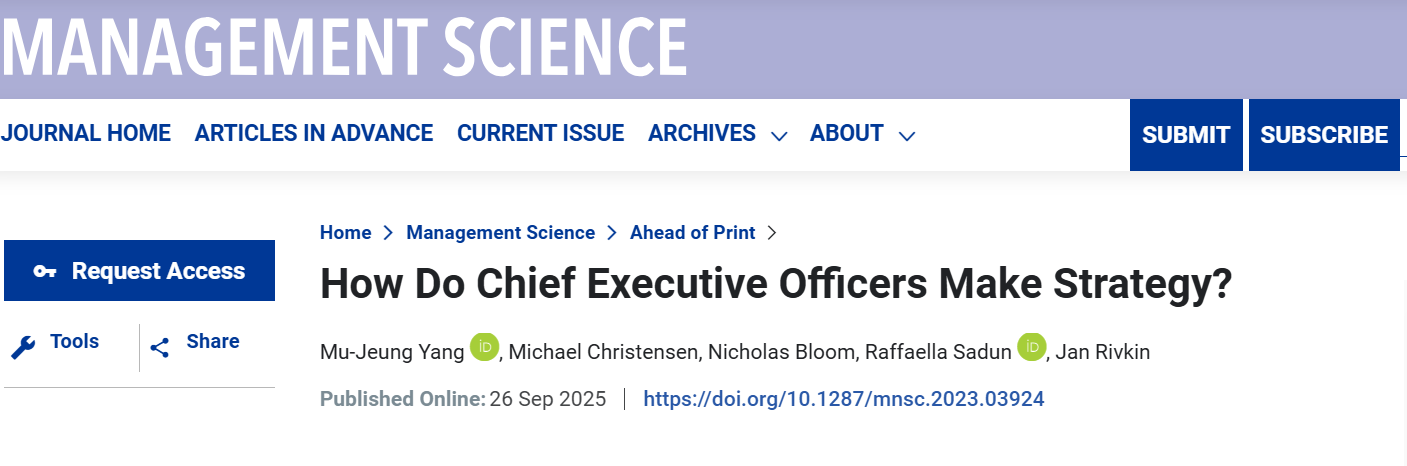
The paper
The authors examine how CEOs actually approach strategy in practice and whether differences in approach matter for firm performance. Using survey data from 262 CEOs across countries and industries, they construct what they call a Strategy Process Index. This index captures how structured, participatory, and disciplined a firm’s strategy making process is.
The central finding is straightforward but powerful. CEOs differ widely in how they make strategy. Some follow highly structured processes, with regular planning meetings, formal documentation, clear communication of priorities, and systematic tracking of execution. Others rely on more informal and ad hoc approaches, where strategy is less explicitly defined, more centralized in the CEO, and less consistently monitored.
These differences are not small. They are large, persistent, and observable even among otherwise similar firms.
More importantly, the study shows that these differences matter. Firms with more structured strategy processes tend to perform better. They exhibit higher productivity, faster growth, and greater profitability. These relationships hold even after accounting for firm size, industry, and country effects.
The authors also show that these differences are partly driven by the CEOs themselves. Leaders with formal business training, such as MBAs, or prior experience in well managed firms are more likely to implement structured strategy processes. This reinforces the idea that managerial background and individual leadership style shape firm outcomes in systematic ways.
Taken together, the paper reframes strategy as an ongoing organizational process rather than a one time decision. Effective CEOs do not just set direction. They build systems for diagnosing problems, formulating choices, communicating priorities, and monitoring execution.
Overall, the key takeaway is that disciplined and well managed strategy processes are an important, and often underappreciated, source of competitive advantage.
Of course, the paper is not without limitations. The findings are largely correlational, so causality remains an open question. It is possible that higher performing firms are simply more likely to adopt structured processes, rather than those processes directly driving performance. The Strategy Process Index itself focuses on formalization, communication, and participation, but it does not directly capture the quality of strategic decisions. That leaves open the possibility that the measure blends effective management with effective strategy.
There are also concerns related to the data. The reliance on CEO self reports may introduce bias, for example a tendency to present practices in a more favorable light. In addition, the emphasis on structured approaches may not fully capture contexts where flexibility and improvisation are valuable, such as startups or highly uncertain environments. Still, these are fairly standard limitations, and the paper provides a strong empirical foundation while leaving room for future work on context, judgment, and strategic content.
Relations to mainstream strategy research
One of the most interesting aspects of the paper is how it connects to earlier management research. It shifts attention away from what strategies firms choose and toward how they develop and execute them. In teaching, it is often difficult to find good material on strategy processes, so there is a tendency to emphasize content and treat process and implementation as secondary. This paper helps correct that imbalance.
It also complements classic strategy frameworks, particularly the dominant content oriented approaches such as Porter’s positioning framework and the resource based view. Yang and coauthors show that even well conceived strategies may underperform if they are not developed and implemented through disciplined processes. That insight is directly useful in the classroom.
At the same time, the paper engages with Mintzberg’s long standing critique of formal planning. Mintzberg emphasized emergence and warned against rigid planning systems. The evidence here points in a slightly different direction. More structured processes are associated with better outcomes, but this should not be read as a blanket endorsement of bureaucracy. A more balanced interpretation is that effective firms combine structure with adaptability. In that sense, the paper helps bridge the divide between deliberate and emergent strategy.
The findings also resonate strongly with Upper Echelons Theory. The idea that organizational outcomes reflect the characteristics of top executives receives direct support here. CEO background, such as education and prior experience, shapes how strategy is made. What is especially valuable is that the paper moves beyond simple demographic correlations and identifies concrete behavioral channels through which CEOs influence performance.
There is, of course, also a clear link to the management practices literature, especially the work by Bloom and Van Reenen. That literature has shown how practices like monitoring and target setting relate to productivity. By focusing on strategy making, this paper extends that line of research into a core domain of executive activity. It shows that strategy itself can be understood as a measurable management practice.
Finally, the paper connects to behavioral strategy. Rather than focusing narrowly on cognitive biases, it highlights how organizational processes can structure and discipline strategic thinking. In doing so, it reduces reliance on intuition alone and embeds decision making in a broader system.
Connection to Foss and Klein
The paper also fits nicely with the argument Peter Klein and I have made in Why Managers Matter (and elsewhere). Our perspective, grounded in organizational economics and Austrian economics, emphasizes that managers are essential because they exercise judgment under uncertainty. Firms exist because not all future contingencies can be specified or priced in markets, so managers must make forward looking decisions about resource allocation. Strategy, in this view, is fundamentally about entrepreneurial judgment.
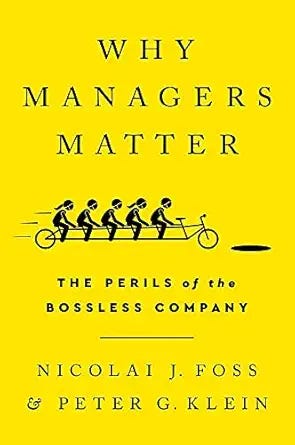
At first glance, Yang and coauthors seem to emphasize something different, namely structured processes. But the two perspectives are better seen as complements rather than substitutes. Their results show that judgment does not operate in a vacuum. Structured processes such as regular meetings, systematic use of data, clear communication, and follow up mechanisms help organize and support decision making.
These processes improve the information available to decision makers, allow for more distributed input, and help ensure consistent execution. In that sense, they do not replace judgment. They discipline it and make it more effective.
The paper’s finding that CEO characteristics shape strategy processes also aligns closely with the idea of heterogeneous managerial capabilities which is central to my work with Peter. Both perspectives (reject the notion that managers are interchangeable. Instead, they are a key source of firm level differences in performance.
A useful way to think about the relationship is that our work explains why managers matter, because judgment is unavoidable under uncertainty, while Yang and coauthors explain how managers matter in practice, through the design and use of strategy making processes.
At the same time, from our perspective the paper arguably underplays the role of radical uncertainty and judgment. This matters because in highly uncertain environments, structure may not always help and may even slow down adaptation. Relatedly, the Strategy Process Index is clever, but it captures formalization and communication rather than the quality of strategic insight (i.e., the quality of judgment). A firm can score highly on process and still pursue a poor strategy.
From a broader microfoundational perspective, the paper focuses on process architecture but says less about the underlying mechanisms. It does not directly address how disagreements are resolved, how power shapes decisions, or how politics and incentives influence strategy making inside firms.
These are, however, relatively minor reservations. The paper is well executed, conceptually interesting, and empirically rich. It is definitely worth your time.
Very interesting. As Prof Foss recognised in the post, the direction of causation could easily run the other way: more successful firms put in place more structured strategy processes. The Granger causality test might have been used to test that one. The idea of bridging the divide between deliberate and emergent strategy is very interesting. I always think about the firm-size distribution when it comes to anything strategy-related. There are quite a few studies showing that it follows a power-law distribution, which is, to some extent, associated with randomness. How much of firm growth is random?
Yang et al.'s work is an interesting and insightful article, and Professor Foss connects the idea with the judgment-based perspective very well. As mentioned, "A firm can score highly on process and still pursue a poor strategy. " We can't easily identify the managerial intentionality of TMT/CXO if they intend to favor themselves, but it is bad for the firm.